platform · semantic markers
Build with Semantic Markers. Run them with your own agents.
ForgeAI gives builders and analysts the tools to define concepts, forge calibrated markers and run them as a control layer inside the agents and pipelines you already have. From the first request, on your own documents.
platform · semantic markers
01 / 07Build with Semantic Markers. Run them with your own agents.
Define concepts, forge calibrated markers and run them as a control layer inside the agents and pipelines you already have.
inside the pipeline · tap a stage
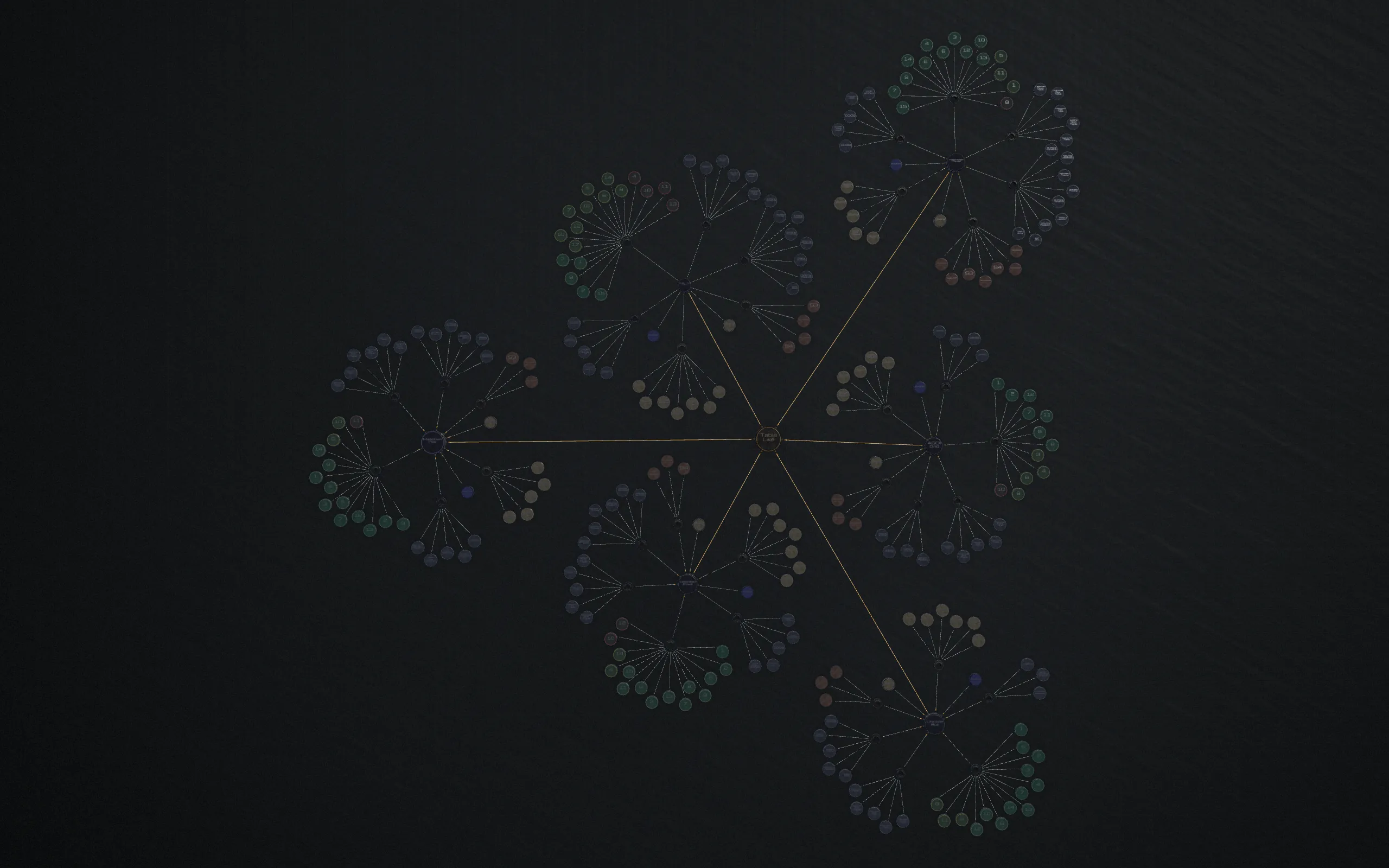
01 define · three layers
From unstructured text to structured signals.
Documents, emails, filings, transcripts. Three layers of semantic schema surface what matters in them. Each layer is a set of Semantic Markers; each marker is one concept with one calibrated score, traced to the passage that triggered it.
The model core only ever sees the text that matters: scored and filtered before inference, validated and explained after it.
Client experts define the concepts that matter. ForgeAI structures them into detection maps across three layers of schema: Base, Business and Custom.
01 define · three layers
02 / 07From unstructured text to structured signals.
Three layers of semantic schema. Each marker is one concept with one calibrated score, traced to the passage that triggered it.
Industry semantics for your sector: supply-chain, counterparty and market risk, named the way your analysts name them.
scored before inference · explained after it
02 forge · how a marker is forged
Every marker is forged from examples, not written as a prompt.
“No other commercial NLP product uses quality-diversity search. ForgeAI is the first.”not one best solution · a structured library of optimal policies
02 forge · how a marker is forged
03 / 07Every marker is forged from examples, not written as a prompt.
what a marker is forged from
Positive examplesComplete coverage of the concept.
Hard negativesPrecision at the concept boundary.
Edge-case variantsThe underrepresented ways production phrases it.
Synthetic example setsPrivacy-safe examples where real ones are scarce or restricted, so regulated teams forge markers without exposing data.
Not one best prompt: a library of operating points. Precision, recall or balance — your call, per deployment.
Every marker must clear specificity, coverage and robustness before it goes anywhere near production.
“No other commercial NLP product uses quality-diversity search. ForgeAI is the first.”
03 govern · routing policy
You set the gate. The platform enforces it, every run.
Confidence thresholds, risk tolerance and review rules are configuration, not prompts. Every result is routed deterministically to automation, to a reviewer or to escalation, and the reason travels with it. Change the policy and the same passage takes a different, equally traceable path.
Try the dial: the three sample passages re-route as you change the policy.
03 govern · routing policy
04 / 07You set the gate. The platform enforces it, every run.
Supplier X — Q3 reviewnegative_projection · flag: reputation
0.91automationKYC file — counterparty 114regulatory_obligation · flag: legal
0.86human reviewAmended supply terms — Marchregulatory_enforcement · no flag
0.78escalation1 of 3 automation1 of 3 review1 of 3 escalation
04 build & integrate · your agents
Use it instantly with your own agents.
Nothing to migrate, nothing to rebuild. Your agents call the control layer over the API: context is gated on the way in, outputs are scored and vetoed on the way out. Your providers, your sources and your deployment pipeline stay exactly where they are.
REST API
Every call scored, vetoed and logged. Connect any backend system in a request; the audit feed comes with it.
SDK for front-end and back-end
Embed governed outputs in websites, dashboards, back-office systems and mobile apps.
Client-selected models
GPT, Claude, Gemini, Llama or Mistral, for LLM and embeddings alike. ForgeAI governs the workflow regardless of provider.
Orchestration frameworks
Your agents call the layer from the first request. Context is gated on the way in, so each agent sees only what it needs.
Files, databases, APIs, clouds
Document collections from your own stores. Ingestion pipelines, vector stores and data lakes on AWS, GCP or Azure.
Version, test, deploy
Every app is versioned and tested before it ships, then deployed over the API with full logs and spend control.
04 build & integrate · your agents
05 / 07Use it instantly with your own agents.
Nothing to migrate, nothing to rebuild. Your agents call the control layer over the API; your providers, sources and pipeline stay where they are.
REST API
Every call scored, vetoed and logged. The audit feed comes with it.
POST /v1/score
{ "text": "…", "schema": "business",
  "threshold": 0.85 }

→ { "score": 0.86, "verdict": "pass",
    "trace": "passage 14 · q3_filing.pdf" }
One call. Score, verdict and trace come back together.
05 the workspace
Define, forge, run and inspect in one workspace.
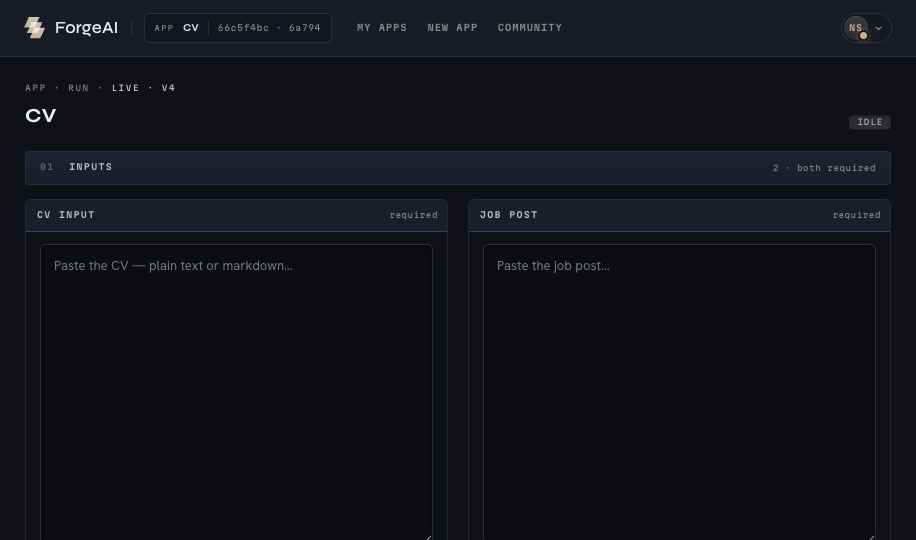
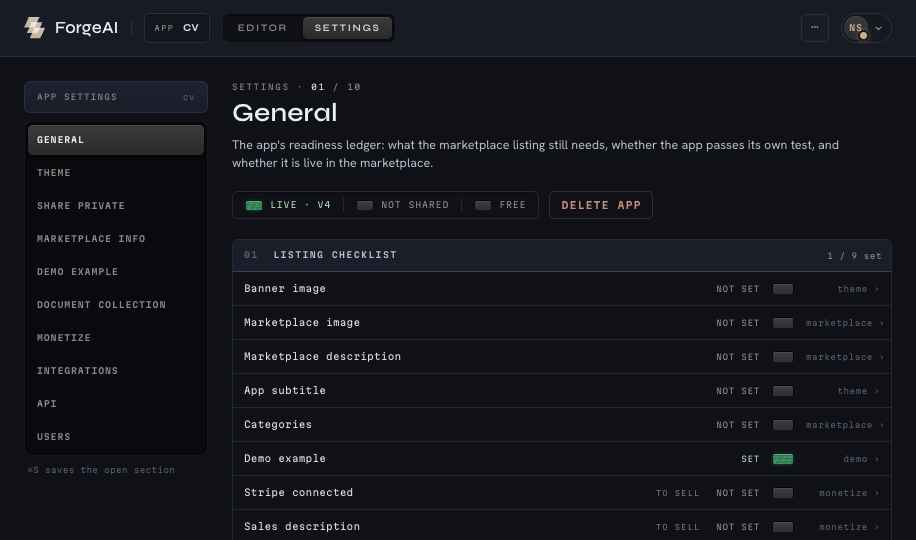
The editor where apps and markers are built, the run surface your analysts use, the concept graph behind every score, and the settings that connect it all to your stack.
05 the workspace
06 / 07Define, forge, run and inspect in one workspace.
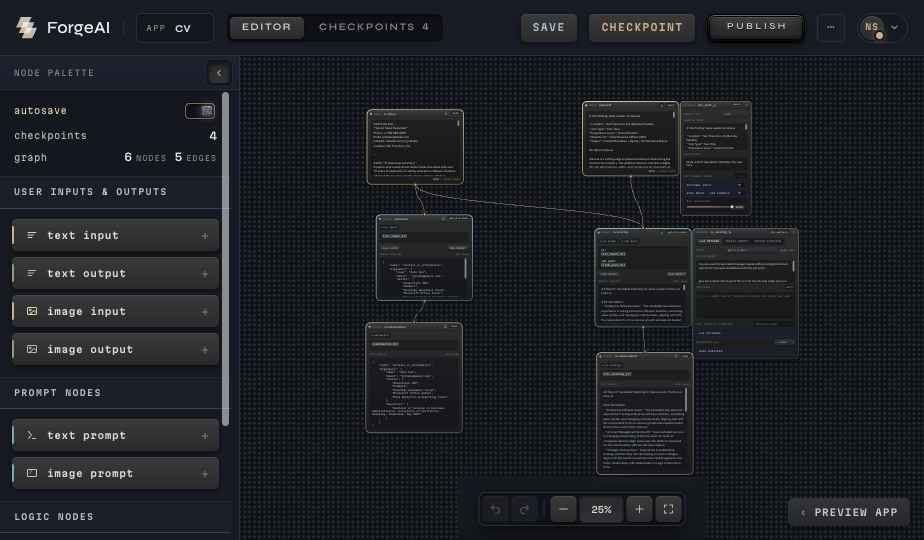
A node graph of inputs, prompts, functions and outputs. Checkpoints, preview, publish.
06 get started · your agents · day one
07 / 07Connect your agents today.
Nothing to migrate, nothing to rebuild. Your agents call the control layer over the API from the first request, on your own documents.